Ciphermail Email Encryption Gateway
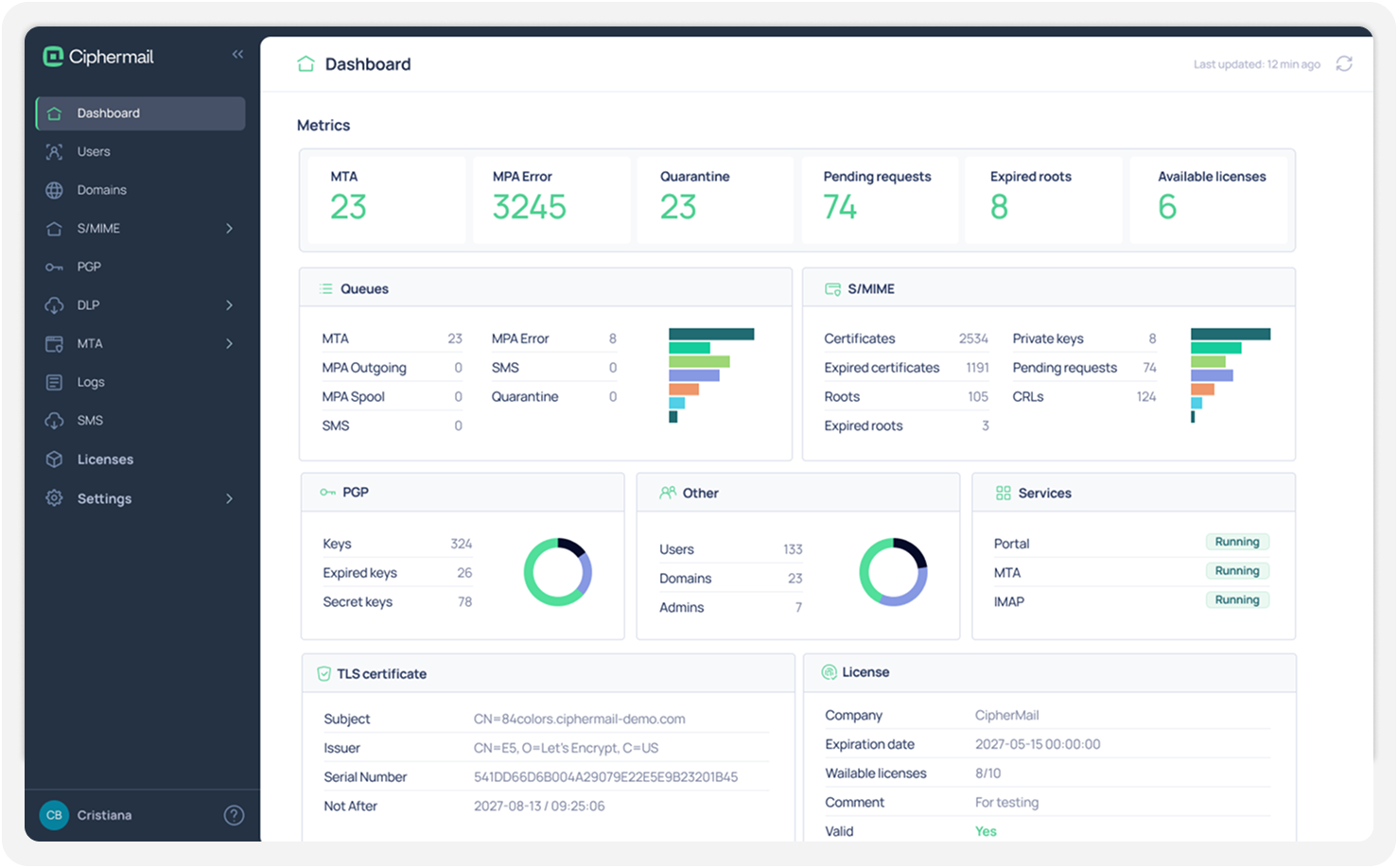

Email encryption that adapts to every recipient. Compatible with all email systems.
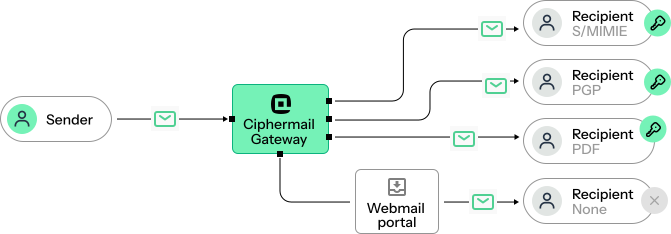
CipherMail Gateway supports major email encryption standards: S/MIME, PGP, PDF encryption, encrypted webmail (Webmail Messenger) and TLS. For each recipient, the gateway automatically detects which method they support and uses it.
Send one email to multiple people with different setups, and each gets a version encrypted the way they can read it. If none of these is possible, the Webmail Messenger fallback still delivers the message securely. PDF encryption is a lightweight option, since recipients only need a PDF reader. Your senders never have to think about it.
Everything your email security needs, in one gateway

Flexible policy setup

Built-in digital signing

Virtual appliance or Linux install

Hardware Security Module

Open source design

Data Leak Prevention

Certificate Request Handlers

Domain-to-domain encryption

Also scriptable from the command line
CipherMail email encryption gateway supports all major encryption standards


S/MIME
S/MIME is a standard way to protect email. With the S/MIME protocol you encrypt messages so only the intended recipient can read them, and add a digital signature to confirm who sent them and that they haven’t been altered. S/MIME is widely used by businesses and government agencies. To use it, each person needs a digital certificate (sometimes called a personal email certificate), which is typically issued and managed by their organization. You can configure the CipherMail Email Encryption Gateway to automatically encrypt and sign email messages using S/MIME.
PGP
PGP is a long-standing standard for encrypting and digitally signing email. Like S/MIME, it protects your messages, but it uses a web-of-trust approach, where people verify each other’s keys, instead of certificate authorities.
The gateway supports PGP/MIME and inline PGP.
PDF Messenger
PDF Messenger is a lightweight alternative to S/MIME and PGP.
PDF Messenger converts your entire email, including all attachments, into a password-protected PDF. It then sends this secure PDF to the recipient, who can open it using any standard PDF reader. The recipient receives the password securely through the CipherMail PDF Authenticator.
Webmail Messenger
Webmail Messenger is a secure webmail portal that works with the CipherMail Email Encryption Gateway to securely send and receive messages to external recipient.
TLS
TLS protects the connection between mail servers by encrypting the path your message travels, but it does not encrypt the message itself. If an email is stored on a server and only TLS was used, the message is typically stored in plain text. Technologies like S/MIME and PGP encrypt the contents of the email itself, so the message remains protected even when stored. For the best security, use S/MIME or PGP together with TLS.
Performance that scales
with your hardware
The number of messages per second the gateway processes, by the type of encryption applied and the size of the attachment. Every message is DKIM signed.
| Encryption | 100 KB | 1 MB | 5 MB | 10 MB | 100 MB |
|---|---|---|---|---|---|
| DKIM only | 23 | 15 | 7 | 4 | 0.5 |
| S/MIME sign | 18 | 11 | 4 | 2 | 0.3 |
| S/MIME sign and encrypt | 17 | 9 | 3 | 2 | 0.2 |
| PGP/MIME sign and encrypt | 16 | 5 | 1 | 1 | 0.1 |
| Encryption | 100 KB | 1 MB | 5 MB | 10 MB | 100 MB |
|---|---|---|---|---|---|
| DKIM only | 30 | 22 | 11 | 6 | 0.6 |
| S/MIME sign | 25 | 15 | 6 | 3 | 0.4 |
| S/MIME sign and encrypt | 24 | 13 | 5 | 2 | 0.3 |
| PGP/MIME sign and encrypt | 24 | 8 | 2 | 1 | 0.1 |
| Encryption | 100 KB | 1 MB | 5 MB | 10 MB | 100 MB |
|---|---|---|---|---|---|
| DKIM only | 46 | 30 | 15 | 9 | 0.8 |
| S/MIME sign | 36 | 22 | 10 | 6 | 0.7 |
| S/MIME sign and encrypt | 33 | 19 | 9 | 5 | 0.5 |
| PGP/MIME sign and encrypt | 36 | 13 | 4 | 2 | 0.2 |
Messages per second, sustained. The tests were run on a default configuration, with all options enabled. Treat the numbers as an indication only: throughput depends on a number of factors, among them processor speed, disk speed, network speed and whether a CRL is checked.